


Many people ask us, what is sufficiency? What does it look like? Is it relevant for organizations looking to maximize profit? How is it distinct from other ways of living – simplicity or sustainability? In this page, we answer some of these questions and more.
What is exquisite sufficiency?
Exquisite sufficiency is a way of organizing our lives, our work, our social systems, and our economy. Exquisite sufficiency asserts that we are enough exactly how we are right now. We do enough each day, each week, each year, and we have enough of whatever it is that’s required within ourselves, our relationships and collectively as a society. In this way, sufficiency is the lived experience of enough. Exquisite sufficiency is NOT about deprivation, settling or limited living. It’s about knowing – through experimentation, inquiry and presence – the threshold that gets us to “enough” and letting go of the habitual our drive for more.
As a mindset, sufficiency becomes the way in which we listen to others – and to ourselves – to discover our true needs and values. Sufficiency guides us, and our clients, to align our actions with clear priorities. We cultivate practices out of sufficiency that lead us to build businesses and lives that will stand the test of time over many generations. Sufficiency is an antidote to anxiety, fear, distraction and shame. It may feel like having gotten enough sleep or a sense of satisfaction for accomplishing enough for the day. In this way, it is less about a number that fits our ideas about enough, and instead is a declaration that empowers us.
Why is sufficiency important?
1. Sufficiency is important because it is an accurate articulation of the laws of nature. Resource is sufficient, and it is finite. The exquisite sufficiency that is here on earth is just that: As human animals, we were gifted with everything we need to thrive including fruit bearing trees, wood and plants to build homes and heal wounds, language to communicate and complex brains to reflect on and invent ourselves and our environment. That said, resources are finite. There is an end to wood, water, clean air, oil, plants that heal, crops that feed. Enough and finite. This is the reality exquisite sufficiency speaks to.
2. Sufficiency as a set of practices may hold the key to what is truly sustainable. A primary practice of sufficiency is to live in the inquiry and to pause before answering. When we ask the question what is enough? a door opens to a future that could actually care for all of life, respect the limits of the earth and return us to the gift that was given for free to all beings.
What are the benefits of living into sufficiency?
Some of tangible, tested benefits we have received in our living in sufficiency experiment and seen in our clients include:
- Creativity – we have seen folks rediscover and embody a new creative self
- Clarity – many of us find ourselves with a clear vision of ourselves and what we are creating for ourselves.
- Honesty – a way to look at the truth of all things. This truth gives us the strength and wisdom to engage in the larger world.
- Purpose: a path of investigation and ways to take action
- Peace of Mind: a general experience of ease, including a natural place of wonder and inquiry about life and the larger world along with a respite from searching.
- Connection: to self, planet and larger human community this sense of belonging. Offers us a rigor that has gives us the space to question our role as consumers in society.
- Faith, Trust and Love: of self and other.
- Resilience – the practices of living into enough generate the capacity to be with difficult circumstances.
What are the problems of sufficiency?
Sufficiency holds space for all, it is simply a way to reflect the reality of life and is wholly inclusive. However, as a body of work and a conceptual paradigm, the biggest problem we see so far is that “sufficiency is not sexy.”
In Western culture, especially in the U.S., where we most of us are programmed to want more and more and more, and where aspiration and striving, big dreams and big goals are the key to our success and happiness, sufficiency begins to sound a bit like settling, compromising, or worse. It is not the truth of sufficiency itself that is the problem, but rather our ability to hear its offering as something that still asks for our greatness.
Secondly, shifting consciousness and culture takes some effort. More of a challenge than a problem, shifting from one set of operating principles to another when still embedded in a system operating from the old principles causes friction both within ourselves and in our world. We experience this in our company’s living experiment and see it as the challenge all leaders and visionaries face.
Who are the current role models of exquisite sufficiency?
- Seven Stones Leadership
- Lynne Twist, Soul of Money Institute
- Miriam Hawley, Enlignment
- Alan Rosenblith, Alternative Currency, Film Maker
- Ana San Juan, Marketing Consultant
- Carol Dearborn, Artist
- Tony Hsieh, CEO Zappos – for generating an environment of joy and connection, a culture of happiness in his organization.
- Craig Newmark – for not selling his beloved website, Craigslist.com, for doing it for love of it, keeping it simple, accessible, and clean of advertising.
- Piya Banjeree, Core Team Member of Generation Up.
What does exquisite sufficiency look like inside an organization?
We are using our organization as a prototype to explore the components of exquisite sufficiency, which are sourced from our seven insights – trust, commitment, community, purpose, wisdom, joy and love. In fact, it is inside of our experiment that we develop these insights!
Joy is contagious passion and play
Wisdom is a deeper understanding
Purpose is both direction and meaning
Community is what makes us powerful
Trust is the foundation of community
Commitment is what connects community to purpose
Love is the source of it all and the antidote to fear
As organization development professionals, when we are invited into an organization, it is often because some aspects of scarcity are putting a strangle hold on the organization. We have a tool for organizations to assess the elements of the scarcity engine that are at work. We most often see a deeply embedded conversation about scarcity of time and resources. We may also see fear and competition and alienation reeking havoc of peoples ability to trust, build effective teams, cultivate a climate where work is pleasurable and innovative instead of full of burden.
Organizations using the seven insights begin to cultivate trust, commitment, passion and joy; they nurture wisdom and act from transparency. In addition, they and look at their metrics for business success and make alterations to expand their definition of success. They see that profit cannot be the only driving force, and yet companies we have seen using similar principals are immensely profitable, such as Zappos. They see that people, culture and community matter, and they are willing to act in ways that broadens conventional thinking.
One would know they worked in an organization operating inside of sufficiency if there were demonstrations of:
- Radical transparency
- Deep accountability
- Unconditional love
- Joy encouraged
- Authentic commitment that includes breakdowns and recovery
- Clear purpose
- Exquisite care
- Allows space for wisdom to emerge
- Small teams
- Sunlight open workspace that enables great work
- Professional development at every level
- Distinctions for leadership, communication, personal mastery
- Dignity for each and every person in the system every day
What would be the criteria of an award in exquisite sufficiency?
A person or entity that:
- Steps over nothing: distinguishes scarcity whenever it is present with compassion and rigor
- Lives committed and to connected to interdependence and creates structures that support the knitting of social fabric
- Clearly brought others along on their sufficiency journey
- Commits to the seven insights practices in every aspect of life and leadership
- Designs the structures of their life to match the insights even if it means they do not maximize personal gain
- Makes all action transparency
***Come back to read case studies from our business clients. We are constantly developing examples of sufficiency in the field. Please contact us if you have some of your own to share!
What is a day in the life of exquisite sufficiency? What are the moments of choice for choosing exquisite sufficiency versus its opposite?
In general, living a life within the context of exquisite sufficiency becomes a moment to moment practice of becoming present. Within sufficiency, we are present to, and receptive of, what is – whatever it is, and we take action from the clarity we experience through this presence. Because being present is often challenging for most adults, being committed to living within sufficiency means embedding practices into our life that allow us to be present to what is and to see clearly, such as meditation, being in nature, keeping our spaces clear and organized, and maintaining relationships that allow our consciousness, joy and purpose to blossom.
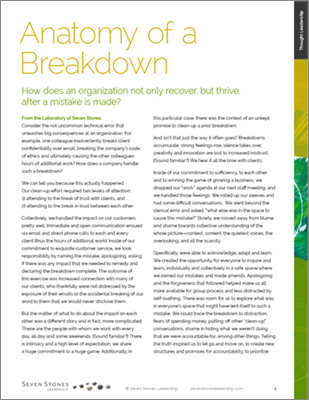
At Seven Stones, for example, we devote the beginning of our weekly meeting to getting present together as a team, focusing our attention on our inner world and aligning it with each other. Most often we use a short visualization, based in our bodies and breath. We have a rigorous commitment not to step over any scarcity, no matter what. (See Anatomy of a Breakdown for more narrative on this.) These relationships are the foundation, the cement for the organization to stand strong so we take care to make sure there are no cracks in the foundation. We get connected to our purpose: why we are here together doing this work: to contribute, to have fun, to make a living to care for our children, to offer our gifts as best we can on any given day. From this space we are able to do our best work, to use our deepest knowing and accessing our wisdom. We find that when we tap this source, our business flourishes.
One of the biggest challenges of living in this context is to recognize the paradox it beholds. That we are trying to win the game – i.e., earn a living to thrive in this modern world, that we are attempting to dismantle – i.e., excess, disparity, comparison, consumerism. It is a tension we discuss and investigate often. So, we chew our food at lunch. We work some and care for our children some and do our best to acknowledge how challenging it is to stay in our own sufficiency in this never ending sea of more to do, more to accomplish, more to create and more money to make. We remind each other and ourselves throughout the day that all we have is now and each other and the path matters as much if not more than the destination. It’s a subtle often unrecognizable but seismic shift.
Is sufficiency related to sustainability?
Yes, sufficiency is related to sustainability in the same way it is related to capitalism, socialism and any economic driver. Sufficiency is a context, and it is one in which sustainability can flourish. We believe that to keep the economic engine based on scarcity and excess, and then to simply shift to fuel that engine with sun and wind power is to only re-arrange the deck chairs on a sinking ship. The era of infinite accumulation on a finite plane is over, as we have reached the limits of our planet’s ability to sustain our appetites. We see this more and more clearly as third of the world’s population wakes up to its role as consumer with the possibility of reaching levels of consumption common in the United States. The need to do, be, make more has created an unprecedented rise in stress related diseases; 87% of modern disease, including cancer, diabetes, heart, and autoimmune disorders, are related to stress.
Inside of exquisite sufficiency, we recognize that we are inextricably connected to everyone else on the planet and we begin to investigate what drives our appetite for more with love and compassion. This is the main distinction from another context in which sustainability projects are undertaken: inside of exquisite sufficiency, there is no blame, no shame, no worry. There is the rigor of inquiry and action with the starting point of acceptance.
What is the opposite of exquisite sufficiency? What does that look like?
The essence of exquisite sufficiency is inclusive. In one way, it has no opposite because it does not exclude. For example, one might be practicing sufficiency and still feel fear, disconnection. A commitment to sufficiency will not save one from discomfort or the difficult sensations of being human and navigating human relationships. In another way, living outside the paradigm of sufficiency, in one embedded in scarcity, looks like always striving for more – money and time, namely; something better – new partner, new job; something faster – new smart phone, computer, car; something different than what is. The opposite of sufficiency is often said to be scarcity – the sense that it, whatever it is, will never be enough. Other thinking asserts that scarcity is on the same continuum as excess, and that sufficiency is wholly a different paradigm. The gift of sufficiency, the power of it, is this inclusiveness and guide towards inquiry and inner reflection. We feel more relaxed, complete and satisfied by what already exists around us. Sufficiency offers us the tools to choose our actions based on our priorities, rather than react based on unconscious drives. What this might look like is that moment to moment we respond to whatever is occurring with acceptance, and then act. The opposite of acceptance is resistance, and this leads to alienation, separation, mistrust, disconnection, shame, fear and other weapons of scarcity.
Is “exquisite sufficiency” interchangeable with “sufficiency”?
Yes. Originally Buckminster Fuller spoke about exquisite sufficiency. When Lynne Twist, author of The Soul of Money, popularized the distinction of sufficiency he offered to her she simply called it “the radical, surprising truth of sufficiency.” As we have worked with people to discuss sufficiency we have noticed that often in this culture in particular when people hear sufficiency they think of settling or just enough or of not really going for it or aspiring, associating it with mediocrity and deprivation. So, as we have played with how to speak powerfully about this distinction, we brought back the word exquisite. The word is, of course, lush and rich and full of promise and captures more fully from our point of view the promise of the sufficiency paradigm.